


The Radium Girls: When a “Glowing” Workplace Became a Deadly Warning
August 24, 2026 | by Bossprp
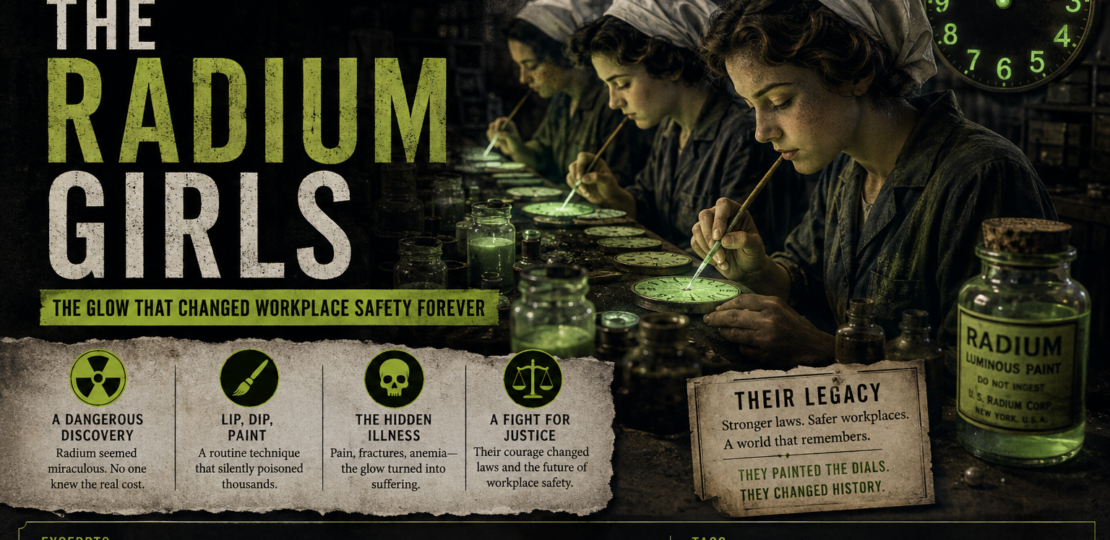
From luminous watch dials and glamorous factory jobs to lawsuits that changed workplace safety, the story of the Radium Girls remains one of the most powerful lessons in occupational health and employee protection.
“The Radium Girls — dial painters working with luminous paint”
The Radium Girls and their dial-painting work.
The glow that promised a better future
In the early decades of the 20th century, radium was almost synonymous with modernity.
Discovered by Marie and Pierre Curie in 1898, radium fascinated scientists, entrepreneurs and the public. Its mysterious glow made it appear almost magical, and its potential medical applications fuelled the belief that it could be beneficial to human health.
Then came the glow-in-the-dark dial.
During and after the First World War, factories in the United States employed thousands of young women to paint watches, clocks and military instrument dials with radium-based luminous paint. For many women, these were attractive jobs: relatively well-paid, skilled and socially respectable.
But beneath the glow was a hazard that nobody could see.
“Lip, dip, paint”
The work required extraordinary precision.
The women had to paint tiny numbers and hands onto watch and instrument dials. To create a fine point on their brushes, they were instructed to place the brush between their lips, shape the tip and then dip it back into the radium paint.
The technique became known as “lip pointing.”
It sounds almost unimaginable today.
Each repetition introduced another tiny amount of radioactive material into the worker’s body. Radium-containing dust could also contaminate clothing, hair and the surrounding workplace.
The tragedy was compounded by the fact that the workers were generally reassured that the material was safe.
Some even regarded the glowing dust on their clothes as something beautiful.
The same workplace that appeared technologically advanced was quietly exposing its workforce to a serious occupational hazard.
When the glow turned into illness
The consequences did not necessarily appear immediately.
For some workers, the first symptoms were seemingly ordinary: toothaches, persistent pain, fatigue or problems with their bones.
Over time, however, some developed severe jaw deterioration, anemia, fractures, tumors and other effects associated with internal radiation exposure. Because radium behaves chemically in ways similar to calcium, the body can deposit it in bone, where its radioactive emissions can cause continuing damage.
The horror of the Radium Girls was therefore not simply that they encountered a dangerous substance.
It was that the workplace hazard followed them home and remained inside their bodies.
The fight for accountability
As the women’s illnesses became increasingly difficult to ignore, some began challenging the companies that had employed them.
In New Jersey, workers associated with the United States Radium Corporation became central figures in a legal battle led by women including Grace Fryer. Scientific investigations, including work by pathologist Harrison Martland, helped establish the connection between their illnesses and radium exposure.
The legal struggle was painfully slow.
Some women were seriously ill while pursuing compensation. Others did not live long enough to see the final outcome.
Their cases nevertheless attracted public attention and helped establish an important principle:
«An employer cannot treat worker safety as secondary to productivity, cost or convenience.»
More than a story about radium
The Radium Girls were not confined to one factory.
Similar incidents involved workers in New Jersey, Illinois and Connecticut. The Illinois Radium Dial Company in Ottawa became another important chapter in the story, with workers suffering serious health consequences after using similar painting techniques.
Their experiences subsequently contributed to scientific research into radiation exposure and occupational disease.
The lessons extended far beyond dial painting.
Research on the workers contributed to the development of radiation protection practices and influenced safety thinking during later nuclear research, including the Manhattan Project.
From “worker welfare” to occupational health
The Radium Girls story is particularly relevant to the evolution of modern EHS/HSE and workplace safety management.
Today, organisations routinely talk about:
– Hazard identification
– Risk assessment
– Hierarchy of controls
– PPE
– Exposure monitoring
– Safety Data Sheets
– Occupational health surveillance
– Emergency preparedness
– Incident investigation
– Regulatory compliance
– Worker consultation
– Management accountability
These concepts may seem like standard corporate processes today.
But history shows why they matter.
A workplace can look productive, clean and technologically sophisticated while hiding a serious hazard.
The biggest lesson for today’s workplace leaders
The Radium Girls offer a lesson that goes beyond radiation.
Safety is not the absence of accidents.
A worker may complete every shift without an obvious incident while being exposed to a hazard that will manifest years later.
That is why modern workplace safety must ask deeper questions:
What can hurt our people today?
What can harm them slowly?
What are we assuming is safe simply because it has always been done that way?
Are workers empowered to challenge unsafe practices?
Are management decisions driven by evidence—or by convenience and productivity pressure?
For Facilities, Administration, EHS and Workplace leaders, this distinction is critical.
A strong workplace is not merely one where buildings operate efficiently.
It is one where people can work safely, speak up safely and return home safely.
The Radium Girls’ enduring legacy
The women who once sat at factory benches painting glowing numbers could never have known the scale of their eventual legacy.
Their suffering helped expose the consequences of inadequate occupational protection. Their persistence forced employers, scientists, doctors, lawyers and regulators to confront a difficult truth:
Work itself can become a source of harm when risk is misunderstood, ignored or deliberately concealed.
The luminous dials eventually became obsolete.
But the lesson remains relevant.
Every new technology, chemical, process, machine, workplace design or productivity initiative carries a fundamental question:
“Have we made it better for the business—or genuinely safer for the people?”
The Radium Girls remind us that the two must never be separated.
A workplace that delivers results but compromises human safety is not a successful workplace.
It is simply a risk waiting for its consequences to become visible.
—
A final thought
The Radium Girls did not set out to change workplace safety.
They simply went to work.
And through their courage, suffering and fight for justice, they helped change the way the world thinks about occupational risk.
Their story began with a glow.
Their legacy is a warning.
And their greatest contribution may be the safety of workers they would never meet.
Historical context verified against records and research from the U.S. National Archives, NIST and peer-reviewed occupational-radiation literature.
RELATED POSTS
View all

शबनम सिन्हा एयरटेल पेमेंट्स बैंक की नई चेयरपर्सन होंगी: 17 खिलाड़ियों को मिलेगा अर्जुन अवार्…
August 22, 2026 | by Arjun Mehta

‘जैसे को तैसा’, पाकिस्तान ने बैरिकेड्स हटाए तो दिल्ली में चला बुलडोजर, पाक हाई कमीशन का सुरक…
August 21, 2026 | by Kenji Tanaka

The 9 Best Tv Shows to Stream This Month (september 2026)
September 16, 2026 | by Kenji Tanaka