


Beyond Maintenance: How CAFM Is Transforming Daily Facility Operations
October 22, 2026 | by Bossprp
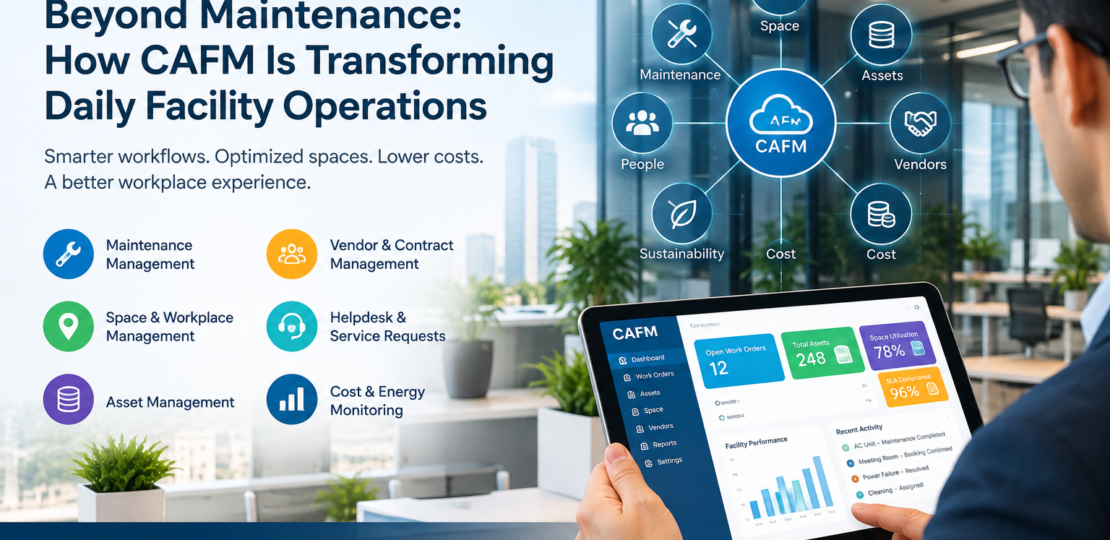
Computer-Aided Facility Management (CAFM) software plays a central role in managing daily facility operations efficiently, proactively, and cost-effectively. It acts as a central platform for managing workplace infrastructure, maintenance, space, assets, vendors, and service requests.
#CAFM
#FacilityManagement #WorkplaceManagement #FacilitiesOperations #SmartBuildings #PreventiveMaintenance #AssetManagement #SpaceOptimization #OperationalExcellence #WorkplaceExperience
Key roles of CAFM in daily operations
1\. Space and Workplace Management
Tracks office occupancy, desk utilization, seating allocation, meeting rooms, floor plans, and space availability to optimize workplace capacity and reduce real estate costs.
2\. Maintenance Management
Schedules preventive maintenance, logs breakdowns, assigns technicians, tracks work orders, and monitors resolution times for HVAC, electrical, plumbing, and other systems.
3\. Asset and Inventory Management
Maintains records of equipment, furniture, warranties, service history, asset location, lifecycle costs, and replacement schedules.
4\. Helpdesk and Service Requests
Provides a single channel for employees to report issues such as AC failures, housekeeping concerns, electrical faults, or seating problems. Requests are prioritized, assigned, tracked, and closed against defined SLAs.
5\. Vendor and Contract Management
Tracks vendor performance, service contracts, contract expiry dates, work completion, compliance documentation, and SLA adherence.
6\. Cost, Energy and Performance Monitoring
Consolidates operating expenses, utility consumption, maintenance costs, and service performance to identify savings opportunities and improve budget control.
How CAFM supports a typical working day
| Operational activity | How CAFM helps |
| ——————– | ———————————————————————————– |
| Start of day | Reviews open complaints, pending work orders and critical equipment alerts |
| During operations | Assigns tasks, tracks housekeeping, maintenance and employee requests |
| Issue escalation | Flags overdue work orders and SLA breaches |
| End of day | Generates reports on closures, pending issues, costs and service quality |
| Monthly reviews | Analyzes occupancy, asset reliability, vendor performance and operating expenditure |
Key business benefits
* Higher operational efficiency: Automates repetitive administrative tasks and reduces manual follow-ups.
* Improved employee experience: Enables faster resolution of workplace issues.
* Lower operating costs: Helps prevent equipment failures, optimize space, and control maintenance expenditure.
* Better compliance: Maintains auditable records for inspections, maintenance, and statutory requirements.
* Data-driven decisions: Provides dashboards and KPIs for facility managers and leadership.
* Greater accountability: Establishes ownership, priorities, response times, and escalation paths.
Important CAFM KPIs
A facility manager can use CAFM data to monitor:
* Work-order SLA compliance (%)
* Mean time to repair (MTTR)
* Preventive maintenance completion (%)
* Repeat complaints and breakdowns
* Cost per square foot or per employee
* Space utilization and occupancy
* Energy consumption per square foot
* Vendor performance and employee satisfaction
Practical example
Suppose an AC unit fails on an office floor. Without CAFM, an employee might call the facilities team, someone manually assigns a technician, and follow-ups happen over phone or email.
With CAFM, the employee logs a request, the system assigns a priority and responsible team, the technician records the diagnosis and repair, and the system tracks the SLA and closure. The resulting data can also reveal recurring faults that justify replacing the equipment rather than repeatedly repairing it.
In summary: CAFM moves facilities management from a largely reactive, manually coordinated function to a more structured, measurable and proactive operation. Its real value comes from combining reliable data, clear workflows, defined SLAs and management accountability—not simply from having the software.
Stay tuned for more details n insights…
RELATED POSTS
View all


Openai-backed Thrive Holdings Raises $2b to Bring Ai to the Enterprise
August 13, 2026 | by Phalguni

Satish Dhawan | Aerospace Engineer, Space Scientist, Fluid Dynamics Research, Isro, & Srihar…
August 13, 2026 | by Kenji Tanaka