Census 2027: 40 Questions That Could Capture a New Picture of India
August 16, 2026 | by Aaditya Raj
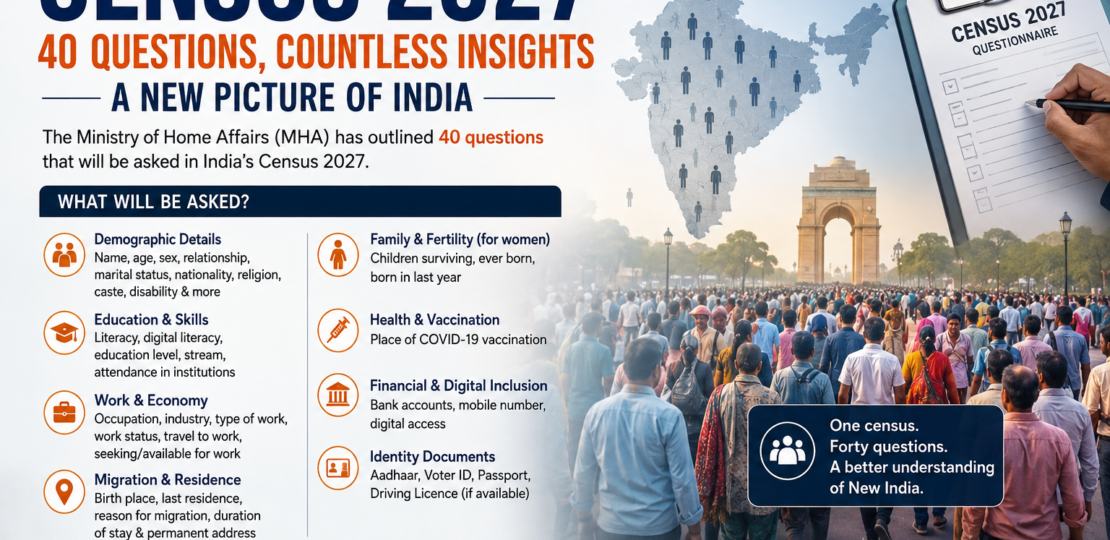
India’s upcoming Census 2027 is set to gather a wide range of information about individuals and households. According to the Ministry of Home Affairs (MHA), the exercise will include 40 questions, covering everything from basic demographic details and education to employment, migration, banking and identity documents.
The questions indicate how India’s population data collection is evolving—from traditional demographic information to aspects of digital access, financial inclusion and identity documentation.
“According to the Ministry of Home Affairs (MHA)” source link: Ministry of Home Affairs – Government of India
The 40 questions include:
- Name of the person
- Relationship to the head of household
- Sex
- Date of birth and age
- Current marital status
- Age at marriage
- Spouse’s name
- Nationality as declared
- Religion
- SC/ST/Caste
- Father’s particulars
- Mother’s particulars
- Disability
- Mother tongue and other known languages
- Literacy and digital literacy status
- Attendance in an educational institution
- Highest educational level and stream/discipline
- Whether the person worked at any time during the last year
- Category of economic activity
- Occupation
- Nature of industry, trade or service
- Class of worker
- Non-economic activity, for marginal, semi-marginal and non-workers
- Whether seeking or available for work
- Travel to place of work
- Place of birth
- Place of last residence
- Reason for migration
- Duration of stay in the present village/town since last migration
- Permanent residential address
- Number of surviving children, for specified currently married, widowed, divorced and separated women
- Number of children ever born alive, for specified currently married, widowed, divorced and separated women
- Number of children born alive during the last year, for currently married women
- Place of COVID-19 vaccination
- Total number of bank accounts
- Mobile number, if available
- Aadhaar number, if available
- Voter ID number, if available
- Passport number, if an Indian passport holder
- Availability of a driving licence
From population counting to a digital-era census
The proposed questionnaire reflects a much broader understanding of population data.
Earlier censuses primarily focused on demography, literacy, occupation, migration, housing and social characteristics. The 2027 exercise, as described by the MHA, goes further by seeking information related to digital literacy, bank accounts, mobile connectivity and identity documents.
The inclusion of Aadhaar, voter ID, passport and driving licence information is particularly notable. At the same time, the wording “if available” is important—it indicates that these documents are being recorded as information about availability rather than making possession a prerequisite for being counted.
Why Census 2027 matters
A census is more than a headcount. Its data can influence how governments understand population distribution, migration patterns, employment, education, social composition, infrastructure requirements and public-service needs.
For a country as large and diverse as India, accurate population data can play an important role in planning everything from schools and hospitals to transport, housing and employment programmes.
One census. Forty questions. A vast amount of information about how India lives, works, moves and connects.
Source: Ministry of Home Affairs (MHA). The questionnaire/details should be read as subject to the official Census 2027 notification and final government instructions.
RELATED POSTS
View all


कीमतें और बढ़ीं तो प्याज-चीनी के बाजार में हस्तक्षेप करेगी दिल्ली सरकार…
August 31, 2026 | by Arjun Mehta

Interviews Conclude, Three Candidates to Be Shortlisted for Ram Temple Trust Ceo
August 13, 2026 | by Vikram Chauhan