After the Flag Comes Down: What Kind of India Are We Building?
August 15, 2026 | by Parashar PR
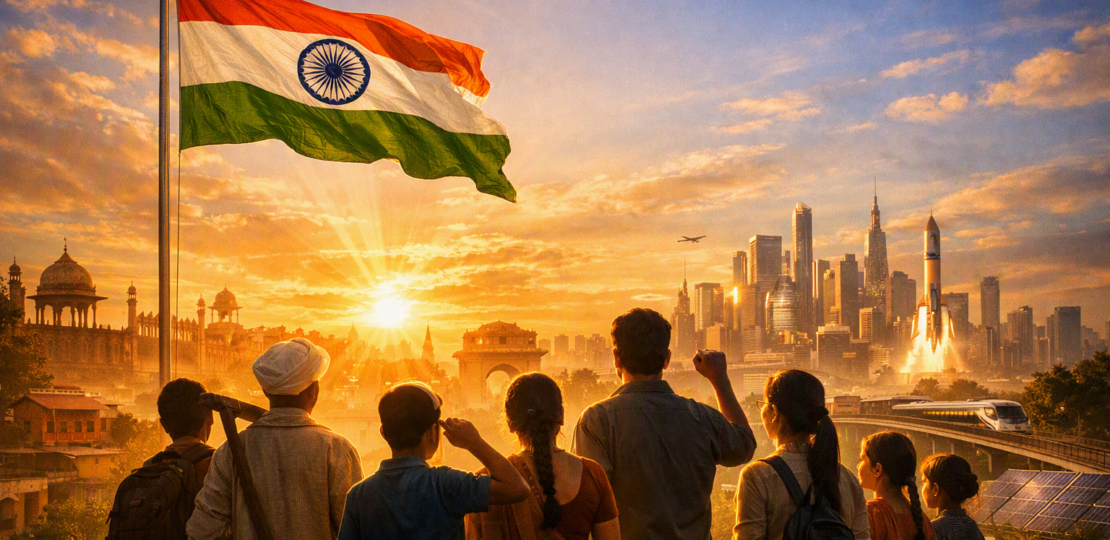
The flag goes up at sunrise. The speeches begin. The anthem plays. And by evening, everything looks normal again.
But what happens to our patriotism when the celebration ends?
Independence Day 2026 Indian Independence Day, 15 August, India of Tomorrow, New India, future of India, Independence Day blog, patriotic blog, India future
Dear India, What Should We Fix Before We Celebrate?
After the Flag Comes Down: What Kind of India Are We Building?
At sunrise, the flag goes up.
For a few hours, India feels different.
The tricolour catches the morning light.
Schoolchildren stand in neat rows, their hands holding tiny paper flags. Someone is adjusting the microphone. Someone is distributing sweets. Somewhere, a patriotic song is playing for the tenth time.
The national anthem begins.
Everyone stands.
For a few minutes, millions of people—across cities, towns, villages, apartments, offices and school grounds—share the same moment.
Then the ceremony ends.
The flag remains.
But slowly, the crowd disappears.
The children go home.
The speeches are forgotten.
The sweets are eaten.
The social media stories expire.
And eventually, the country returns to an ordinary Wednesday, Thursday or Friday.
But here is the question we rarely ask:
What happens after the flag comes down?
Because perhaps that is when Independence Day really begins.
Not when the anthem plays.
Not when the hashtag trends.
Not when we post a photograph with the tricolour.
But when we return to our ordinary lives.
When we go back to work.
When we open our phones.
When we enter our classrooms.
When we drive through our streets.
When we raise our children.
When we make decisions about money, education, technology, nature and society.
That is where the future of India is actually being built.
And perhaps this Independence Day, instead of asking only how proud we are of India, we should ask something more uncomfortable:
What kind of India are we creating?
The India We Inherited
Every generation receives an India that it did not create.
We inherited its roads.
Its cities.
Its languages.
Its institutions.
Its stories.
Its contradictions.
Its achievements.
Its problems.
And, above all, its dreams.
The generation that lived through independence imagined a country that could stand on its own feet.
The generations that followed built schools, factories, farms, laboratories, businesses, institutions and communities.
They made mistakes.
They achieved remarkable things.
They left unfinished work.
And now, that unfinished work has quietly reached us.
We are living in an India that is changing faster than many generations before us could have imagined.
A young person in a small town can access knowledge from across the world.
A small business can find customers far beyond its neighbourhood.
An Indian engineer can work with a team spread across continents.
A creator with nothing more than a phone can reach millions.
A student can learn skills that were almost impossible to access a generation ago.
The possibilities are enormous.
But so are the questions.
Because progress is not only about how fast we can move.
It is also about where we are going.
We Are Building the Future Without Realising It
The future of India will not suddenly arrive one morning.
There will be no announcement saying:
“Welcome to the future.”
It will happen quietly.
One classroom at a time.
One startup at a time.
One scientific discovery at a time.
One village adopting a new technology at a time.
One young person choosing to learn a new skill at a time.
One family deciding to educate a daughter at a time.
One citizen choosing not to litter at a time.
One entrepreneur creating a job at a time.
One teacher inspiring a child at a time.
One person deciding to listen rather than hate.
This is the strange thing about nation-building.
We imagine it as something enormous.
We imagine Parliament.
We imagine skyscrapers.
We imagine highways.
We imagine satellites.
We imagine giant factories and futuristic cities.
And yes, those things matter.
But nations are also built through incredibly ordinary moments.
The way a teacher talks to a student.
The way a parent treats a daughter.
The way a driver behaves on the road.
The way a business treats its employees.
The way a citizen treats public property.
The way we speak to someone who cannot do anything for us.
The future is often hiding inside ordinary behaviour.
The Young India Question
Walk into almost any Indian city today and you can feel the energy.
Young people are everywhere.
They are studying.
Building companies.
Making films.
Designing products.
Creating music.
Learning artificial intelligence.
Starting businesses.
Preparing for examinations.
Working night shifts.
Building online communities.
Dreaming of leaving India.
Dreaming of transforming India.
Sometimes both.
This generation has access to possibilities that previous generations could only imagine.
But it also carries a strange pressure.
Be successful.
Be productive.
Build a career.
Build a personal brand.
Make money.
Stay updated.
Stay relevant.
Stay visible.
And somehow, while doing all this, figure out what kind of life you actually want.
The question for young India is no longer simply:
“What job will I get?”
It is becoming:
“What can I build?”
That is a powerful shift.
Because a country changes when its young people stop seeing themselves only as consumers of the future and start seeing themselves as creators of it.
But What About the India Outside Our Screens?
There is another India.
The India that doesn’t always appear in our social media feeds.
The farmer leaving home before sunrise.
The woman running a small business from a crowded neighbourhood.
The student travelling a long distance to attend school.
The worker building the road we drive on.
The sanitation worker beginning their day while the rest of the city sleeps.
The teacher working in a classroom with limited resources.
The small shop owner trying to survive rising costs.
The artisan preserving a skill passed down through generations.
The family in a village watching its children dream of opportunities far beyond the village itself.
This India matters just as much.
Because a country’s progress cannot be measured only by its most impressive buildings.
It must also be measured by the lives of people who rarely appear in those buildings.
The India we build must not be an India that leaves millions behind while celebrating how far the rest have travelled.
Progress has to travel.
Opportunity has to travel.
Education has to travel.
Technology has to travel.
And hope has to travel.
From the biggest cities to the smallest villages.
The India We Build on the Internet
There was a time when a person’s voice was limited by geography.
Today, geography is almost irrelevant online.
A thought can travel across the country in seconds.
A video created in a small room can reach millions.
A lie can do the same.
And that creates a completely new responsibility.
We are not merely using the internet.
We are collectively creating its culture.
Every comment contributes something.
Every share contributes something.
Every argument contributes something.
Every piece of misinformation contributes something.
Every thoughtful conversation contributes something.
We often complain about the toxicity of the internet.
But the internet is also a reflection of us.
If we reward outrage, outrage grows.
If we reward misinformation, misinformation spreads.
If we reward thoughtful content, creators notice.
If we choose empathy, empathy becomes visible.
So perhaps one of the most important questions for modern India is not:
“What is social media doing to us?”
It is:
“What are we doing to the social media culture we are creating?”
Because the digital India of tomorrow is being written today—one click at a time.
Can We Grow Without Losing What Makes Us Human?
India wants growth.
And it should.
We want better infrastructure.
Better technology.
Better healthcare.
Better education.
Better jobs.
Better connectivity.
Better cities.
Better opportunities.
But there is another kind of development we rarely measure.
Can we become more prosperous without becoming less compassionate?
Can our cities become smarter without becoming colder?
Can technology become more powerful without making people more disconnected?
Can ambition exist without destroying empathy?
Can we compete globally while still remembering the value of community?
These questions matter because development is not only about what we build around us.
It is also about what we become while building it.
A city can have glass towers and still have lonely people.
A country can have advanced technology and still struggle with basic kindness.
A person can have millions of followers and still feel unheard.
Progress should make life more human, not less.
That may be one of the greatest challenges of the India ahead.
What Will Happen to Our Languages, Stories and Traditions?
India’s future will be modern.
But modern should not mean memoryless.
We are surrounded by thousands of years of stories, languages, music, food, crafts, architecture, festivals and traditions.
Some are changing.
Some are disappearing.
Some are finding new life online.
A young creator can take an old folk song and introduce it to millions.
A regional filmmaker can tell a story that reaches audiences far beyond its original language.
A traditional craft can find customers across the world.
Technology does not necessarily have to erase culture.
It can help preserve it.
But only if we care enough to pass it forward.
Because a country is not defined only by what it invents.
It is also defined by what it remembers.
The India of tomorrow should be technologically ambitious and culturally confident.
It should be able to launch satellites and still listen to its folk songs.
It should build modern cities without forgetting the stories of the places beneath them.
It should speak the language of the future without becoming ashamed of the languages of its past.
The Environment Question We Cannot Ignore
There is another India we are building.
It is visible in the air.
In the rivers.
In the forests.
In the heat of our cities.
In changing weather patterns.
In disappearing green spaces.
We often talk about development as though nature is an unlimited resource waiting to be used.
It isn’t.
The India of 2050, 2070 and 2100 will inherit the environmental choices we make today.
Every tree matters.
Every river matters.
Every clean public space matters.
Every sustainable design decision matters.
Every reduction in waste matters.
This doesn’t mean development has to stop.
It means development has to become smarter.
The real question is not whether India should grow.
It is:
Can India grow without making the future pay the bill?
That is a question our generation cannot postpone forever.
What Does Patriotism Look Like on an Ordinary Tuesday?
Perhaps this is where Independence Day becomes personal.
Patriotism is easy on August 15.
The flag is everywhere.
The music is everywhere.
The colours are everywhere.
But what does patriotism look like on an ordinary Tuesday?
When there is traffic.
When someone cuts the queue.
When a public wall has been damaged.
When nobody is watching.
When we are frustrated.
When we disagree.
When we have an opportunity to take an unfair advantage.
When someone needs help.
When we have to choose between convenience and responsibility.
Maybe patriotism looks surprisingly ordinary.
Doing good work.
Paying fairly.
Teaching someone.
Keeping a public place clean.
Protecting a tree.
Respecting another person’s dignity.
Speaking honestly.
Listening carefully.
Building something useful.
Helping someone who is struggling.
Maybe loving a country is less about how loudly we say its name and more about how carefully we treat the people who live in it.
The India of Tomorrow Will Be Decided by What We Teach Children Today
Ask a child what India should look like in the future.
The answer might surprise you.
They may not talk about GDP.
They may not talk about global rankings.
They may simply say:
“I want clean streets.”
“I want good schools.”
“I want my parents to be safe.”
“I want to become a scientist.”
“I want to play.”
“I want to travel.”
“I want to help animals.”
“I want to become a doctor.”
“I want to build something.”
Children don’t need perfect countries.
They need possibilities.
They need adults who believe in them.
They need education that encourages curiosity rather than fear.
They need spaces where failure isn’t treated as the end of the world.
They need to learn that success is not simply about earning more.
It is also about becoming more capable, more curious and more human.
The India of tomorrow begins in the questions we allow children to ask today.
What If India at 100 Is Not Just About Numbers?
As India moves toward the centenary of independence in 2047, there will inevitably be conversations about milestones.
Economic growth.
Infrastructure.
Technology.
Science.
Global influence.
Urbanisation.
Innovation.
All of these matter.
But perhaps there should be another list.
How safe do people feel?
How hopeful are young people?
How accessible is quality education?
How respected is honest work?
How clean are our public spaces?
How healthy are our communities?
How much do we trust one another?
How well do we treat people who are different from us?
How easily can a child imagine a future beyond their circumstances?
These are harder things to measure.
But they may tell us more about the country we are becoming.
A truly developed India should not only be powerful in the world. It should also feel better to live in.
We Don’t Need to Wait for 2047
It is tempting to think of the future as a distant destination.
Then 2050.
Then 2100.
But the future doesn’t begin in those years.
It begins today.
The India of 2047 is being shaped by today’s classrooms.
Today’s policies.
Today’s businesses.
Today’s parents.
Today’s students.
Today’s creators.
Today’s scientists.
Today’s voters.
Today’s citizens.
Every generation gets a chance to influence the country it leaves behind.
We have ours.
And perhaps that is the most exciting part.
We are not merely waiting to discover the future.
We are participating in its creation.
So, What Kind of India Are We Building?
An India that is richer—but is it kinder?
More connected—but are we more united?
More digital—but are we more thoughtful?
More ambitious—but are we more patient?
More global—but are we still connected to our roots?
More powerful—but are we using that power wisely?
These questions do not have simple answers.
And perhaps they shouldn’t.
A country as complex as India cannot be reduced to one definition.
It is a contradiction.
A conversation.
A work in progress.
A collection of millions of dreams happening at the same time.
That is what makes India fascinating.
We are not finished.
And maybe we never will be.
Because every generation gets to add something to the story.
When the Flag Comes Down, Our Work Begins
So this August 15, enjoy the celebration.
Raise the flag.
Listen to the anthem.
Eat the sweets.
Take the photograph.
Call your family.
Remember the people who made independence possible.
Be proud.
But when the flag comes down, don’t let the feeling come down with it.
Take something with you.
A question.
A thought.
A promise.
A small idea.
Maybe start a conversation with your child.
Maybe support a local business.
Maybe plant something and care for it.
Maybe learn something new.
Maybe help someone.
Maybe stop sharing information you haven’t verified.
Maybe listen to someone whose life is very different from yours.
Maybe simply decide to do your work a little better.
Because India is not built only on historic days.
It is built on ordinary days.
And tomorrow morning, when August 15 is over and life looks ordinary again—
that is when the real work begins.
🇮🇳 One Country. A Million Futures.
There is no single India of tomorrow.
There are millions of them.
There is the India a student dreams about.
The India a farmer hopes for.
The India an entrepreneur wants to build.
The India a parent wants for their child.
The India a scientist imagines.
The India an artist creates.
The India a worker struggles toward.
The India a young person wants to explore.
The India an elderly person hopes will be kinder to the next generation.
All these Indias exist in our imagination.
The challenge is to bring the best of them together.
To create a country where ambition does not destroy compassion.
Where growth does not erase culture.
Where technology does not replace humanity.
Where diversity does not become division.
Where success does not belong only to the fortunate.
Where opportunity is not a privilege reserved for a few.
That is the India worth building.
Your India. Your Future. Your Turn.
This Independence Day, instead of asking only:
“How proud are you of India?”
Ask yourself:
“What kind of India do I want to wake up in twenty years from now?”
Then ask one more question:
“What am I doing today to help create it?”
You don’t need to change the whole country.
Start somewhere.
Start with your work.
Your family.
Your street.
Your classroom.
Your business.
Your phone.
Your community.
Your choices.
Because every great national story is ultimately made from small personal stories.
🇮🇳 Tell Us: What Should India Look Like in 2047?
Complete this sentence:
“By 2047, I want India to be a country where __________.”
Maybe you want cleaner cities.
Better education.
More opportunities.
Stronger communities.
More innovation.
Greater equality.
A healthier environment.
Or simply a kinder society.
Write your answer in the comments.
And if this article made you think beyond the usual Independence Day celebration, share it with someone who is also thinking about the India we are leaving behind.
Because the next chapter doesn’t belong to someone else.
It belongs to us.
The Flag Will Come Down. The Story Won’t.
Tomorrow, the tricolour will come down.
The stage will disappear.
The microphone will be packed away.
The children will return to school.
The office will reopen.
The traffic will return.
The internet will move on to the next trending topic.
But India will continue.
And so will the story.
A story being written in classrooms and laboratories.
On farms and factory floors.
Inside startups and small shops.
On streets and smartphones.
In homes and hospitals.
By teachers, students, workers, entrepreneurs, artists, scientists, farmers, soldiers and millions of ordinary citizens.
The flag comes down.
But the responsibility of building India does not.
So this Independence Day, don’t just celebrate the country we inherited.
Think about the country we are creating.
Because one day, another generation will stand beneath the tricolour.
They will look back at us.
And perhaps they will ask:
“When you had the chance to shape India, what did you build?”
Let us hope we have an answer worth giving.
Happy Independence Day. 🇮🇳
Jai Hind.
RELATED POSTS
View all


Bhagalpur Peace Committee Meets Over Ganesh Puja and Chauth Chandr Concerns
September 17, 2026 | by Ritika Verma